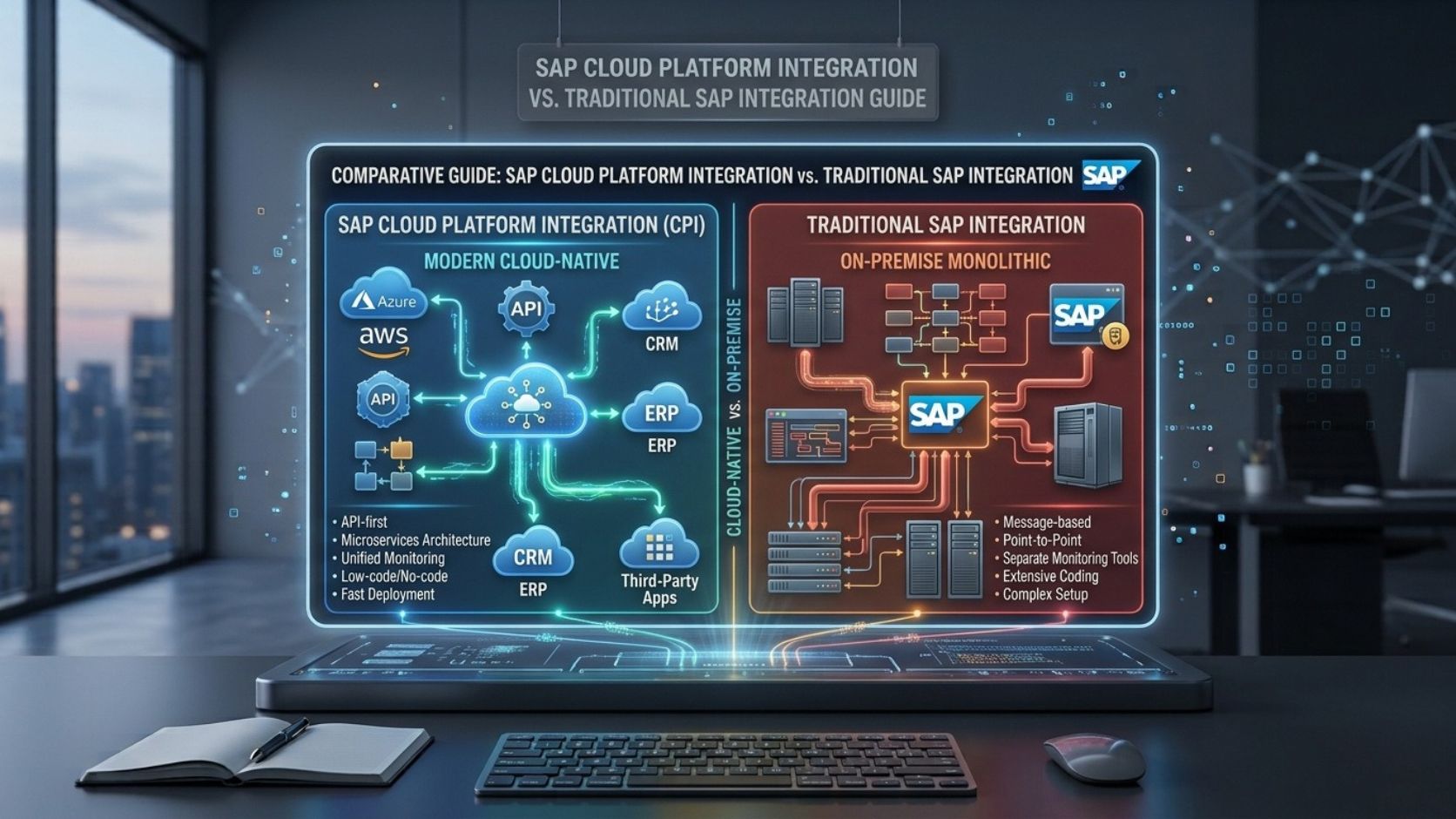
SAP integration has changed as organizations have moved from on-premises systems toward cloud applications and hybrid IT environments. Traditional SAP integration commonly relies on technologies such as SAP Process Integration, SAP Process Orchestration, IDocs, RFC, and direct system connections. SAP Cloud Platform Integration provides a cloud-based approach for connecting SAP and non-SAP applications through integration flows, APIs, adapters, and managed connectivity.
SAP Cloud Platform Integration is commonly known as SAP CPI. The capability is now part of SAP Integration Suite and is generally referred to as Cloud Integration. It supports cloud-to-cloud, cloud-to-on-premises, SAP-to-SAP, and SAP-to-non-SAP integration scenarios.
Understanding the differences between SAP Cloud Platform Integration and traditional SAP integration requires comparing architecture, deployment, connectivity, development, security, monitoring, scalability, and connection management. Destinations can also play an important role in modern SAP cloud architectures.
What Is SAP Cloud Platform Integration?
SAP Cloud Platform Integration is a cloud-based integration service used to connect applications, APIs, SAP systems, and external platforms.
It provides an integration layer where developers can create integration flows. These flows define how messages are received, transformed, routed, and delivered.
A basic architecture is:
Source System → Cloud Integration → Target System
For example, SAP S/4HANA Cloud can exchange customer or order information with Salesforce through an integration flow.
The flow can receive the message, validate the data, transform the structure, and send it to the target application.
What Is Traditional SAP Integration?
Traditional SAP integration refers to integration architectures based mainly on on-premises SAP systems and technologies.
SAP Process Integration, or SAP PI, was widely used as an enterprise integration platform. SAP Process Orchestration, or SAP PO, extended integration and business process capabilities.
Other traditional technologies include IDocs, RFC, BAPIs, SOAP services, and direct system connections.
A traditional architecture may look like:
SAP System → SAP PI/PO → External System
The integration platform is generally deployed and managed within an organization’s infrastructure.
This approach can support large and complex enterprise environments, particularly where core SAP systems remain on-premises.
SAP Cloud Platform Integration vs Traditional SAP Integration
The main difference is the deployment and architecture model.
SAP Cloud Platform Integration operates as a cloud service. Traditional SAP integration platforms such as SAP PI and SAP PO are commonly associated with on-premises infrastructure.
This difference affects infrastructure management, connectivity, deployment, scaling, maintenance, and integration with cloud applications.
SAP Cloud Platform Integration is designed for modern hybrid and cloud integration requirements. Traditional SAP integration technologies remain relevant in environments that depend on existing on-premises systems and interfaces.
Neither approach represents a single solution for every integration scenario. The appropriate architecture depends on the systems, interfaces, business requirements, security model, and deployment environment.
Architecture Comparison
Traditional SAP integration often uses an integration server deployed within the organization’s infrastructure.
For example:
SAP ERP → SAP PI/PO → External Application
The organization is responsible for infrastructure, system administration, upgrades, networking, and other operational requirements associated with the platform.
SAP Cloud Platform Integration uses a cloud-based integration runtime.
A typical architecture is:
SAP S/4HANA → Cloud Integration → Salesforce
The cloud service provides the integration runtime and related platform capabilities.
This architecture is designed to support applications distributed across cloud and on-premises environments.
Deployment Differences
Deployment is one of the clearest differences.
Traditional SAP integration platforms are commonly installed within an organization’s data center or private infrastructure.
This means the organization manages the underlying environment.
SAP Cloud Platform Integration is delivered as a cloud service within SAP Integration Suite.
Cloud deployment reduces the need for customers to install and maintain the integration runtime infrastructure themselves.
The organization still needs to configure integration content, connectivity, authentication, monitoring, and other integration settings.
Infrastructure Management
Traditional SAP integration can require infrastructure planning for servers, operating systems, databases, networking, storage, backups, and system maintenance.
SAP Cloud Platform Integration uses SAP-managed cloud infrastructure for the integration service.
This changes the operational responsibilities of the organization.
The customer focuses more on integration configuration, business logic, interfaces, security, monitoring, and connected systems instead of maintaining the underlying integration server infrastructure.
Connectivity
Traditional SAP integration often relies on technologies such as RFC, IDoc, SOAP, file transfer, and other SAP interfaces.
Modern SAP cloud integration supports these types of enterprise scenarios while also providing connectivity for cloud applications and APIs.
HTTP and REST-based integration are especially important in cloud architectures.
For example:
Cloud Application → REST API → Cloud Integration → SAP S/4HANA
This model supports communication between applications that may operate in different cloud environments.
APIs and Modern Integration
APIs are an important part of modern application architecture.
Traditional SAP systems can expose APIs through technologies such as SOAP, OData, RFC, and other interfaces.
SAP Cloud Platform Integration can consume and process API requests from cloud applications and external platforms.
REST APIs commonly use HTTP methods such as GET, POST, PUT, and DELETE. JSON is widely used for REST-based data exchange.
This makes API-based integration a significant part of cloud integration architectures.
The Role of Destinations
Destinations are an important concept in SAP cloud environments.
A Destination provides connection information that an application or service can use to communicate with another system.
This information can include a target URL, authentication method, and other connection properties.
In traditional integration architectures, connection information may be configured directly within integration systems or application configurations.
Modern SAP cloud architectures can use Destinations to separate connection configuration from application logic where supported.
For example, a development environment can use a test endpoint while production uses a live endpoint.
Destinations can therefore help manage environment-specific connection information.
The exact configuration depends on the SAP service, target system, and authentication method.
Development and Integration Flow Design
Traditional SAP PI/PO development commonly uses integration objects such as message types, interfaces, mappings, communication channels, and integration configurations.
SAP Cloud Platform Integration uses graphical integration flows.
An integration flow can contain a sender, receiver, adapters, mappings, routers, converters, content modifiers, scripts, and exception-handling components.
For example:
Sender → HTTP Adapter → Mapping → Router → Receiver
This graphical model represents the message-processing sequence.
The development approach is therefore aligned with cloud-based integration patterns while still supporting many enterprise integration requirements.
Message Transformation
Both traditional SAP integration and SAP Cloud Platform Integration support data transformation.
Traditional SAP environments can use message mappings and transformation technologies associated with SAP PI/PO.
SAP Cloud Platform Integration also provides message mapping and transformation capabilities.
For example, a source application may provide:
Customer_ID
while the target application requires:
CustomerNumber
The integration layer maps the source field to the target field.
Transformation can also include data type conversion, value changes, field combinations, and structural changes.
Monitoring and Error Handling
Both traditional and cloud integration platforms provide monitoring capabilities.
Traditional SAP PI/PO environments can use platform-specific monitoring tools to track message processing.
SAP Cloud Platform Integration provides cloud-based monitoring for integration artifacts and message processing.
Administrators can investigate errors such as invalid data, failed authentication, unavailable endpoints, mapping problems, and target-system failures.
Exception handling can be configured inside integration flows.
This allows technical teams to separate successful processing from failed processing and investigate problems more efficiently.
Security Comparison
Security requirements exist in both traditional and cloud integration environments.
Traditional SAP integration can use enterprise network controls, certificates, authentication mechanisms, firewall rules, and other security technologies.
SAP Cloud Platform Integration supports authentication mechanisms such as OAuth, basic authentication, client certificates, and other supported methods.
HTTPS can encrypt data during transmission.
Cloud environments also require careful management of identities, credentials, permissions, endpoints, and certificates.
The specific security architecture depends on the connected applications and organizational requirements.
The Role of Destinations in Modern SAP Integration
Destinations can simplify how cloud applications access external services.
For example, a cloud application may need to access an SAP API. Instead of embedding the endpoint and authentication information directly into application code, the application can use a configured Destination where supported.
This can help separate technical connection settings from business logic.
Traditional SAP integration can use different connection mechanisms based on the technology and architecture.
The use of Destinations is therefore more closely associated with SAP’s cloud application and connectivity architecture.
Cloud-to-Cloud Integration
Traditional SAP integration was primarily designed around enterprise systems that often operated within controlled network environments.
Modern businesses commonly use several cloud applications.
For example:
SAP S/4HANA Cloud
SAP SuccessFactors
Salesforce
External Logistics Platform
These systems may operate in different cloud environments.
SAP Cloud Platform Integration can provide a central integration layer between them.
The integration flow can receive data from one cloud application, transform it, and send it to another application through APIs or supported adapters.
Hybrid Integration
Many organizations still operate a combination of cloud and on-premises systems.
For example, SAP ERP may remain on-premises while CRM and HR applications operate in the cloud.
A hybrid architecture can connect these environments through SAP Cloud Platform Integration and appropriate secure connectivity.
A typical architecture can be:
On-Premises SAP System → Secure Connectivity → Cloud Integration → Cloud Application
This allows organizations to connect existing SAP infrastructure with newer cloud applications.
Scalability and Operations
Traditional integration platforms require infrastructure planning based on expected message volume, system capacity, and processing requirements.
Cloud integration changes the infrastructure management model because the integration service operates within SAP’s cloud environment.
However, integration performance still depends on message size, message volume, processing complexity, network conditions, and the capacity of connected systems.
Architecture planning is still necessary for high-volume integrations.
The use of Destinations can also support connection configuration across cloud application environments where appropriate.
Maintenance and Upgrades
Traditional SAP PI/PO environments require customers to manage system maintenance, patches, upgrades, operating system dependencies, and infrastructure components according to their deployment model.
With SAP Cloud Platform Integration, SAP manages the underlying cloud service infrastructure.
Customers still need to maintain integration flows, mappings, credentials, endpoints, certificates, and connected-system configurations.
This creates a different operational model rather than eliminating integration management.
When to Use SAP Cloud Platform Integration
SAP Cloud Platform Integration is suitable for scenarios involving cloud applications, APIs, hybrid environments, and SAP-to-non-SAP connectivity.
It is particularly relevant when an organization needs to connect applications distributed across cloud and on-premises environments.
Examples include S/4HANA integration, SuccessFactors integration, Salesforce connectivity, API integration, e-commerce integration, and third-party logistics systems.
When Traditional SAP Integration Is Still Relevant
Traditional SAP integration remains relevant where existing SAP PI/PO environments support established business processes.
Organizations may have hundreds of existing interfaces based on IDocs, RFC, SOAP, or other technologies.
Migrating these interfaces requires planning, testing, security analysis, and business validation.
An organization may therefore operate traditional and cloud integration technologies together during a transition period.
The appropriate approach depends on the current architecture and future integration requirements.
Migration from Traditional SAP Integration to Cloud Integration
Moving from SAP PI/PO to SAP Cloud Platform Integration requires an integration assessment.
Existing interfaces should be reviewed to determine their protocols, mappings, dependencies, authentication methods, message volumes, and business importance.
The migration process may involve redesigning some integrations rather than simply copying them.
For example, an existing SOAP integration may be redesigned around an API-based architecture when the target application provides an appropriate API.
Testing is required to verify that migrated interfaces produce the expected results.
Production migration should be planned to avoid disruption to critical business processes.
Frequently Asked Questions
What is the difference between SAP CPI and traditional SAP integration?
SAP Cloud Platform Integration is a cloud-based integration service, while traditional SAP integration commonly uses on-premises technologies such as SAP PI, SAP PO, RFC, IDoc, and SOAP-based interfaces.
Is SAP Cloud Platform Integration the same as SAP CPI?
Yes. SAP CPI is the commonly used abbreviation for SAP Cloud Platform Integration. The capability is now part of SAP Integration Suite and is generally called Cloud Integration.
Are Destinations used in SAP Cloud Platform Integration?
Destinations are used in SAP cloud environments to provide connection information for applications and services. Their exact role depends on the application architecture and integration scenario.
What are Destinations used for?
Destinations can contain information such as a target URL, authentication method, and connection properties. They can separate connection configuration from application logic where supported.
Is SAP PI still used?
Existing SAP PI environments continue to operate in many organizations. However, SAP’s integration portfolio has evolved toward SAP Integration Suite and cloud-based integration capabilities.
Can SAP Cloud Platform Integration connect on-premises systems?
Yes. It can participate in hybrid architectures that connect on-premises SAP systems with cloud applications through appropriate connectivity mechanisms.
Which is better for cloud integration?
The appropriate technology depends on the architecture. Cloud-based integration is designed for cloud and hybrid scenarios, while existing traditional integration platforms may continue to support established on-premises interfaces.
Can SAP Cloud Platform Integration use APIs?
Yes. API-based integration is an important part of modern cloud integration. REST, SOAP, OData, and other supported technologies can be used depending on the integration scenario.
Conclusion
SAP Cloud Platform Integration and traditional SAP integration use different architectural approaches to solve enterprise connectivity requirements.
Traditional SAP integration commonly relies on on-premises technologies such as SAP PI, SAP PO, RFC, IDocs, and SOAP. SAP Cloud Platform Integration provides a cloud-based integration environment designed for modern cloud, hybrid, API-based, SAP-to-SAP, and SAP-to-non-SAP scenarios.
The main differences involve deployment, infrastructure management, connectivity, development models, cloud application support, monitoring, and operational responsibilities.
Destinations are another important part of modern SAP cloud architecture. They can provide reusable connection information and help separate endpoint configuration from application logic in supported scenarios.
For organizations with existing SAP PI or SAP PO environments, migration does not necessarily mean replacing every interface immediately. Existing interfaces should be assessed individually based on technology, business requirements, security, dependencies, and future architecture.
As SAP environments continue to combine cloud and on-premises applications, SAP Cloud Platform Integration provides a cloud-based approach for managing integration across these systems.
Leave a Reply